
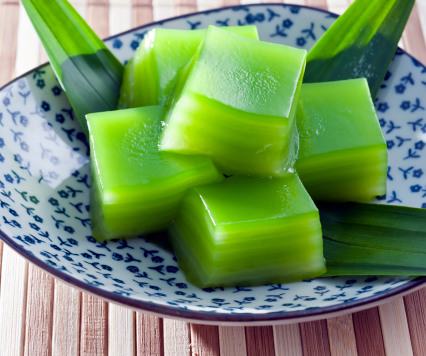
Coconut milk imparts a rich oiliness to the layers, so a few pieces go a long way. The aroma and taste, a fragrant perfume of sweet jasmine and nutty pandan, is as unique as the stodgy texture of this dessert. When you pull the cake from the tray after it’s cooled, don’t worry about being too delicate as the thick sheet of khanom chan will handle a bit of stretch and pull without tearing. If you don’t have a 10 x 10 inch tray, use any heatproof square or rectangular tray-like container.
Ingredients
- One 400 millilitre tin coconut milk (NOT reduced fat)
- 250 grams white sugar
- 100 grams arrowroot flour
- 40 grams tapioca flour
- 30 grams non-glutinous rice flour
- Pinch of salt
- 200 millilitres jasmine water (made by steeping a few jasmine flowers – dried are fine – in water overnight OR with a few drops of jasmine essence)
- 3-4 pandan leaves, chopped into ¼ inch pieces OR a combination of pandanus extract and green food dye
- Food colouring (optional)
Directions/Method
- Combine the coconut milk and sugar in a saucepan. Cook on medium heat just until the sugar is dissolved, avoiding bringing the liquid to the boil. Set aside until completely cool.
- Add plenty of water to the base of your steamer (recommended: a tiered metal Chinese steamer) and heat to a slow steady boil. Place a 10 x 10 inch tray onto a tier in your steamer and leave for 20 minutes to until very hot.
- Mix the flours and salt together in a bowl. Whisk the cooled sweetened coconut milk into the bowl, ensuring there are no lumps by straining the mix through a fine mesh sieve. Evenly divide the mixture into two portions.
- Make the pandan water by blending half of the jasmine water with the pandan leaves. Strain the pandan water into one half of the divided coconut mix with a fervour, pressing with as much effort as you can muster to extract all of the liquid (and flavour). Add the remaining 100 millilitres of jasmine water to the other half of the coconut mixture.
- Pour a very thin layer of either mix into the tray, aiming for just a couple or 3 millimetres in thickness (around ⅓ cup per layer in a 10×10 tray). Tip the steamer slightly, if necessary, so that the dough evenly covers the bottom of the tray. Steam for 12-15 minutes, during which time the layer will set and will appear dry with an even opaque look. Carefully remove the lid, wiping it with a tea towel to keep water from dripping onto the cake (if using a Chinese steamer with a domed lid).
- Add the second layer, again with the same minimal thickness, and steam for a further 12-15 minutes. Repeat, alternating white and green layers, until you have used all of the slurry. Remember to top up the steaming water if it gets low and to always wipe the lid each time you remove it. After adding the final layer, steam for 20-25 minutes to set.
- Set aside to cool completely before cutting and serving. Khanom chan is best on the day it’s made, but will last a few more at a stretch and about a week in the fridge (although the texture may become slightly less chewy.

 EASY THAI FOOD