Look Choop
Ingredient
1. 150 grams Steamed Green Beans peel and soaked in water for 1 night.
2. 1 Tbsp. Red Food Coloring.
3. 1 Tbsp. Green Food Coloring
4. 1 Tbsp. Orange Food Coloring
5. 130 grams Sugar
6. 25 grams Gelatin Powder
7. 1 Liter of Water
8. 250 ml. Coconut Milk
9. 1/2 Tsp. Jasmine Smell
10. 1/2 Cup of China Box-Tree Leave
How to Cook
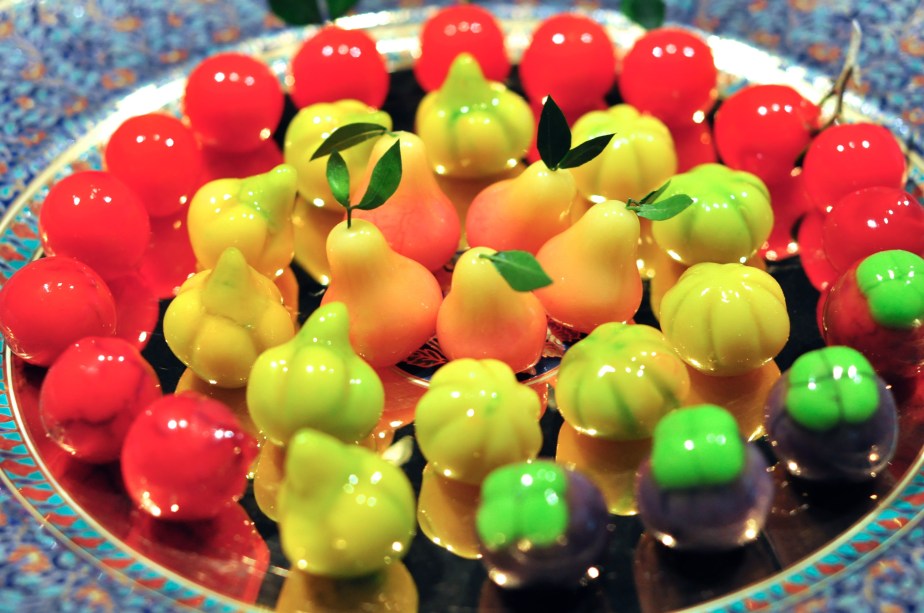
1. Blend soft cooked beans, coconut milk and sugar together until fine. Then stir in a brass pan with low heat until the mixture starts to dry. Set aside to cool.
2. Mold in any shape as you like. Then paint color and set aside for 10 minutes.
3. Mix gelatin powder with water and stir well to combine. Set aside 5 minutes. Turn heat up to boiling water. Then reduce heat to low.
4. Coat Look Choop with gelatin and set aside 5 minutes. Then coat it again 3 times.
5. Decorated with China Box-Tree leave and finish.
Thai Holy Brazil stir fry (Pad Gra Pow)
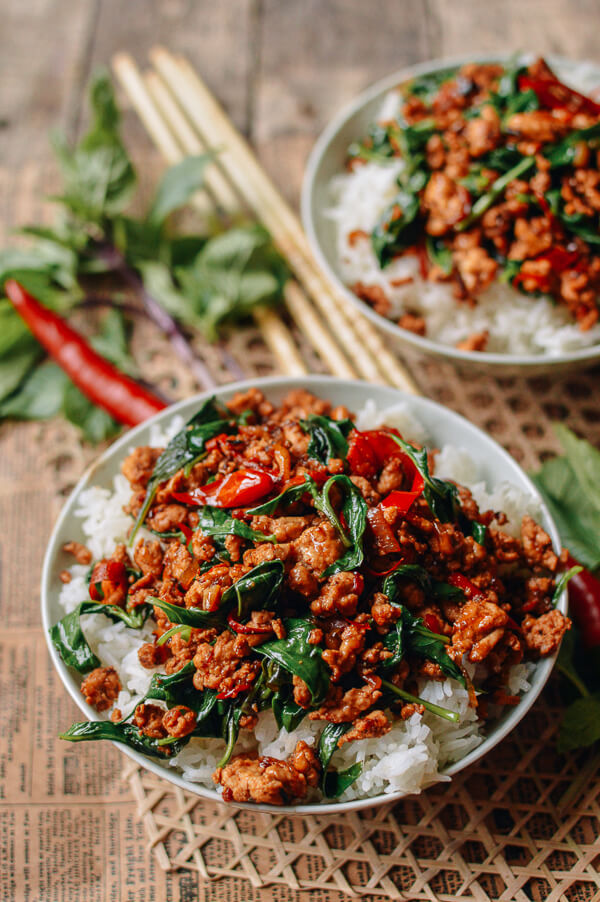
Ingredients
- 3 to 4 tablespoons oil
- 3 Thai bird or holland chilies, de-seeded (if desired) and thinly sliced
- 3 shallots, thinly sliced
- 5 cloves garlic, sliced
- 1 pound ground chicken
- 2 teaspoons sugar or honey
- 2 tablespoons soy sauce
- 1 tablespoon fish sauce
- ⅓ cup low sodium chicken broth or
Instructions
- In a wok over high heat, add the oil, chilies, shallots and garlic, and fry for 1-2 minutes. Add the ground chicken and stir-fry for 2 minutes, breaking up the chicken into small bits.
- Add the sugar, soy sauce, and fish sauce. Stir-fry for another minute and deglaze the pan with the broth. Because your pan is over high heat, the liquid should cook off very quickly. Add the basil, and stir-fry until wilted. Serve over rice.
Sticky rice with mango
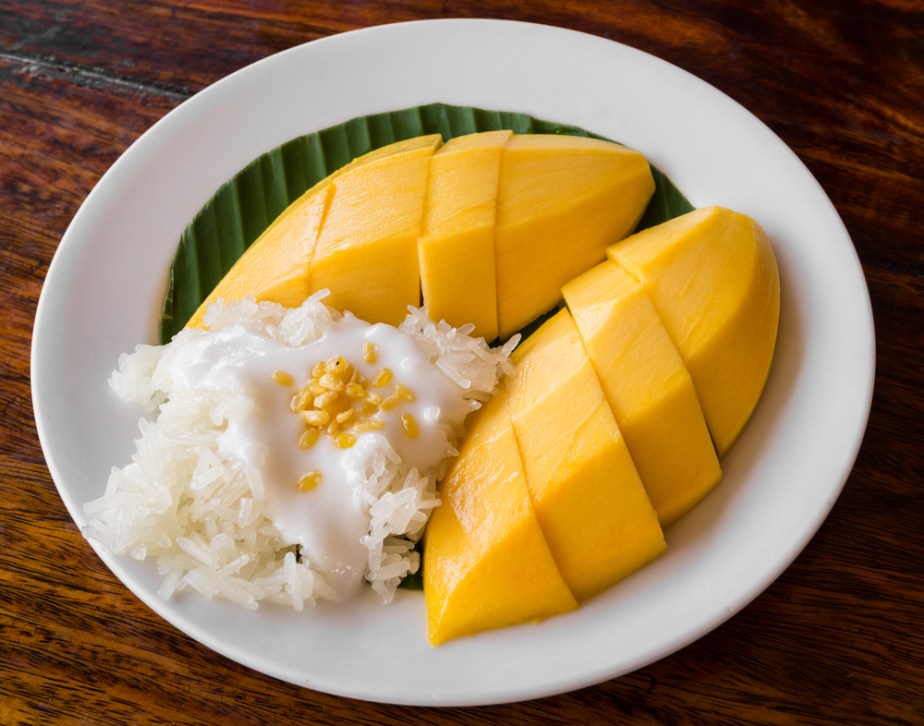
Sticky rice with mango video recipe
INGREDIENTS
-
- 1 1/2 cups glutinous (sweet) rice
- 1 1/3 cups well-stirred canned unsweetened coconut milk
- 1/3 cup plus 3 tablespoons sugar
- 1/4 teaspoon salt
- 1 tablespoon sesame seeds, toasted lightly
- 1 large mango, peeled, pitted, and cut into thin slices (at least 24)
PREPARATION
-
- In a bowl wash rice well in several changes of cold water until water is clear. Soak rice in cold water to cover overnight.
- Drain rice well in a sieve. Set sieve over a large deep saucepan of simmering water (sieve should not touch water) and steam rice, covered with a kitchen towel and a lid, 30 to 40 minutes, or until tender (check water level in pan occasionally, adding more water if necessary).
- While rice is cooking, in a small saucepan bring 1 cup coconut milk to a boil with 1/3 cup sugar and salt, stirring until sugar is dissolved, and remove from heat. Keep mixture warm.
- Transfer cooked rice to a bowl and stir in coconut-milk mixture. Let rice stand, covered, 30 minutes, or until coconut-milk mixture is absorbed. Rice may be prepared up to this point 2 hours ahead and kept covered at room temperature.
- While rice is standing, in cleaned small pan slowly boil remaining 1/3 cup coconut milk with remaining 3 tablespoons sugar, stirring occasionally, 1 minute. Transfer sauce to a small bowl and chill until cool and thickened slightly.
- To serve, mold 1/4 cup servings of sticky rice on dessert plates. Drizzle desserts with sauce and sprinkle with sesame seeds. Divide mango slices among plates.
Pad See Ew
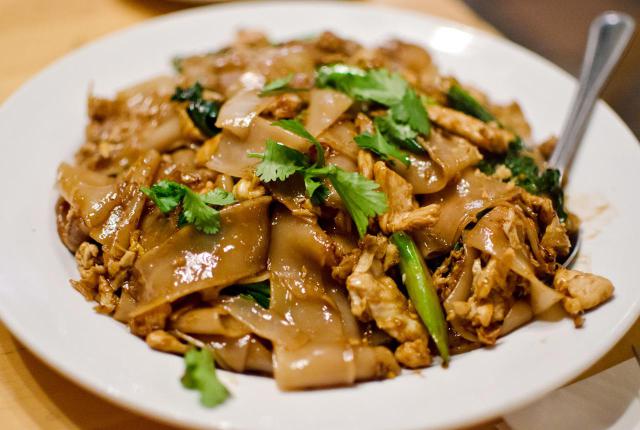
INGREDIENTS
Noodles
- 6oz / 180g dried wide rice stick noodles, or 9 oz / 280g fresh wide flat rice noodles (Sen Yai) (Note 1)
Sauce
- 2 tablespoons dark soy sauce (or sub with kecap manis) (see notes for substitutes)
- 2 tablespoons oyster sauce
- 2 teaspoons soy sauce (normal all purpose soy sauce)
- 2 teaspoons white vinegar (plain distilled white vinegar)
- 2 teaspoons sugar (white or brown)
- 2 tbsp water
Stir Fry
- 2 tbsp peanut or vegetable oil
- 2 cloves garlic cloves
- 1 cup / 150g / 5oz chicken thighs (boneless, skinless), cut into bite size pieces
- 1 large egg
- 4 cups (packed) Chinese broccoli, leaves separated from stems (cut stems vertically into thin sticks)
INSTRUCTIONS
- Prepare the noodles according to packet instructions. Some just require soaking in boiling water for 5 minutes, others require cooking in a pot of boiling water for a few minutes. For fresh noodles, soak in boiled water in a bowl for a few minutes – do not boil in a pot. Drain when ready.
- Meanwhile, combine sauce ingredients.
- Mince the garlic straight into the wok with the oil. Place wok high heat. As the oil is heating, the garlic will gradually heat too and infuse the oil with flavour.
- When the oil is hot and the garlic is starting to turn golden, add the chicken and Chinese broccoli stems and stir fry for 1 minute.
- Move the chicken and Chinese broccoli to one side and crack in the egg, and scramble it. Don’t worry if some of it sticks to the wok, it will char as you continue cooking – you want that chargrilled flavour!
- Add the noodles, Chinese broccoli leaves and the sauce. Fold gently to combine, for the sauce to coat the noodles evenly and to caramelise, and the leaves to just wilt. They only need to be just wilted because they will continue to cook while you are plating up.
- Serve immediately.
NOTES
1. Pad See Ew is traditionally made with Sen Yai rice noodles which are wide, flat rice noodles. These are quite difficult to find, even at Asian grocery stores here in Sydney, Australia. The best substitute is to use wide rice stick noodles. I use Pad Thai, the widest you can find at supermarkets here.
2. Dark soy sauce is thicker and slightly sweeter than normal soy sauce, and has a more complex flavour. It is available in Asian grocery stores and in the asian section of most large supermarkets. A great substitute is kecap manis which is an Indonesian sweet soy sauce. Otherwise, to make your own substitute, use 1½ tbsp soy sauce with 1 tbsp honey instead of 2 tbsp sweet soy sauce.
Normal soy sauce – I use Kikkoman. Look for a soy sauce bottle that does not say dark, light, sweet or salt reduced on it!
3. If you can’t find Chinese broccoli, you can substitute with other leafy Chinese vegetables such as pak choy or bok choy. You can also add other vegetables if you wish.
4. You can substitute the chicken with other proteins suitable for stir frying, even tofu or prawns.
4. You can use other noodles if you want, fresh or dried, rice or egg noodles. However, I do not recommend using vermicelli as it is too thin for the strong flavours of the sauce.
5. If you accidentally add the noodles into the pan before checking they are properly rehydrated, simply add ½ cup of water to the pan and bring it boil, tossing the noodles to finish “cooking” them. It won’t take long because rice noodles do not require much cooking – maybe 1 minute or so, and the dish will still come out fine (though if you already added the broccoli leaves then they will be very wilted rather than just slightly wilted).
Round Egg Yolk Tart
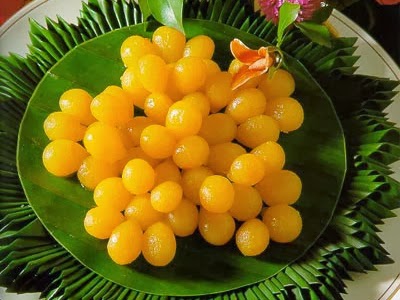
Ingredients
- Sugar
- Egg
- Rice flour
Preparation
- Melt 500 grams of Sugar with 500 grams of water on Medium to low temperature. After it boiled, Turn off the stove. Let it cool down.
- Filter 3 egg yolks and its membrane by squeezing the egg yolk through cheese clothes.
- Whip and stir egg yolk until its volume is raised up. Gradually add 1 tablespoon of Rice Flour and keep whipping it until it is mixed thoroughly.
- Melt another 500 grams of Sugar with 500 grams of water on Medium to low temperature. Keep boiling it.
- Use a spoon to scoop the egg yolk mixture, then drop it in the boiling syrup. The shape of mixture would be a water drop shape.
- When the mixture drops are cooked, take them out from the boiling syrup and leave them in the cool syrup instead.
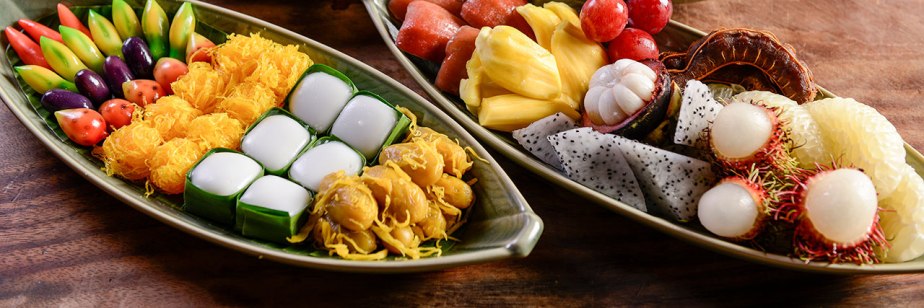
Thai desserts
For a delicious Thai dessert recipe, look no further than this fantastic list of Thai desserts! Asian desserts are naturally low in fat and calories while remaining high in flavor, texture, and taste. Many of these Thai desserts are also lactose and gluten free, so perfect for those with special diet requirements. Looking for an easy dessert recipe? You’ll find a variety of easy desserts here that you can whip up in no time. Enjoy one of these colorful and flavorful Thai desserts tonight!
The history of Thai food


Thai food is internationally famous. Whether chilli-hot or comparatively bland, harmony is the guiding principle behind each dish. Thai cuisine is essentially a marriage of centuries-old Eastern and Western influences harmoniously combined into something uniquely Thai. Characteristics of Thai food depend on who cooks it, for whom it is cooked, for what occasion, and where it is cooked. Dishes can be refined and adjusted to suit all palates.
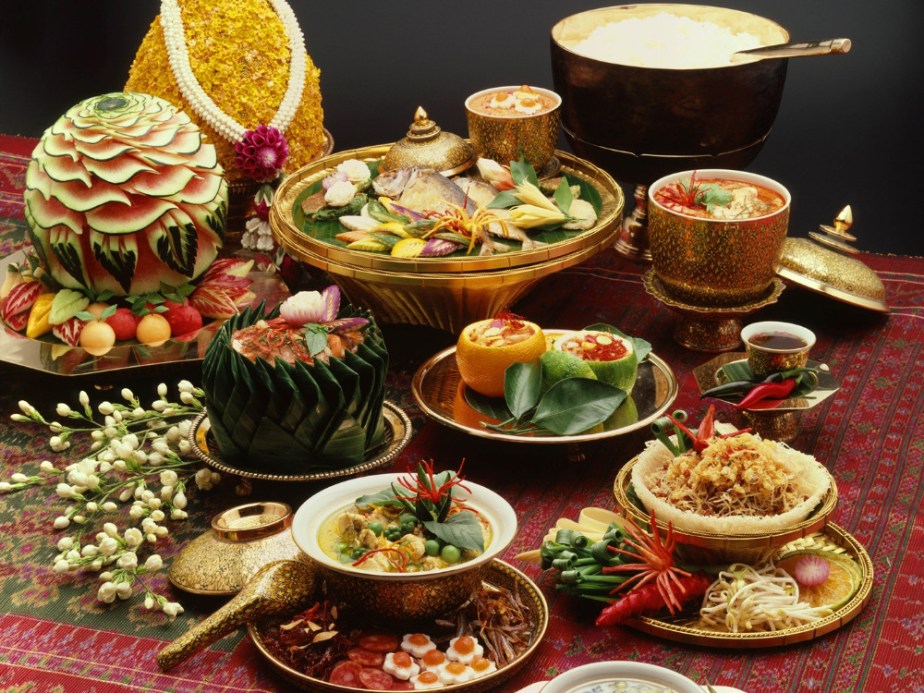
Originally, Thai cooking reflected the characteristics of a waterborne lifestyle. Aquatic animals, plant and herbs were major ingredients. Large chunks of meat were eschewed. Subsequent influences introduced the use of sizeable chunks to Thai cooking. With their Buddhist background, Thais shunned the use of large animals in big chunks. Big cuts of meat were shredded and laced with herbs and spices. Traditional Thai cooking methods were stewing and baking, or grilling. Chinese influences saw the introduction of frying, stir-frying and deep-frying. Culinary influences from the 17th century onwards included Portuguese, Dutch, French and Japanese. Chillies were introduced to Thai cooking during the late 1600s by Portuguese missionaries who had acquired a taste for them while serving in South America. Thais were very adapt at “Siameseising” foreign cooking methods, and substituting ingredients. The ghee used in Indian cooking was replaced by coconut oil, and coconut milk substituted for other dairy products.
Overpowering pure spices were toned down and enhanced by fresh herbs such as lemon grass and galanga. Eventually, fewer and less spices were used in Thai curries, while the use of fresh herbs increased. It is generally acknowledged that Thai curries burn intensely, but briefly, whereas other curries, with strong spices, burn for longer periods. Instead of serving dishes in courses, a Thai meal is served all at once, permitting diners to enjoy complementory combinations of different tasters.
A proper Thai meal should consist of a soup, a curry dish with condiments, a dip with accompanying fish and vegetables. A spiced salad may replace the curry dish. The soup can also be spicy, but the curry should be replaced by a non-spiced item. There must be harmony of tastes and textures within individual dishes and the entire meal.
Tom Yum Khung
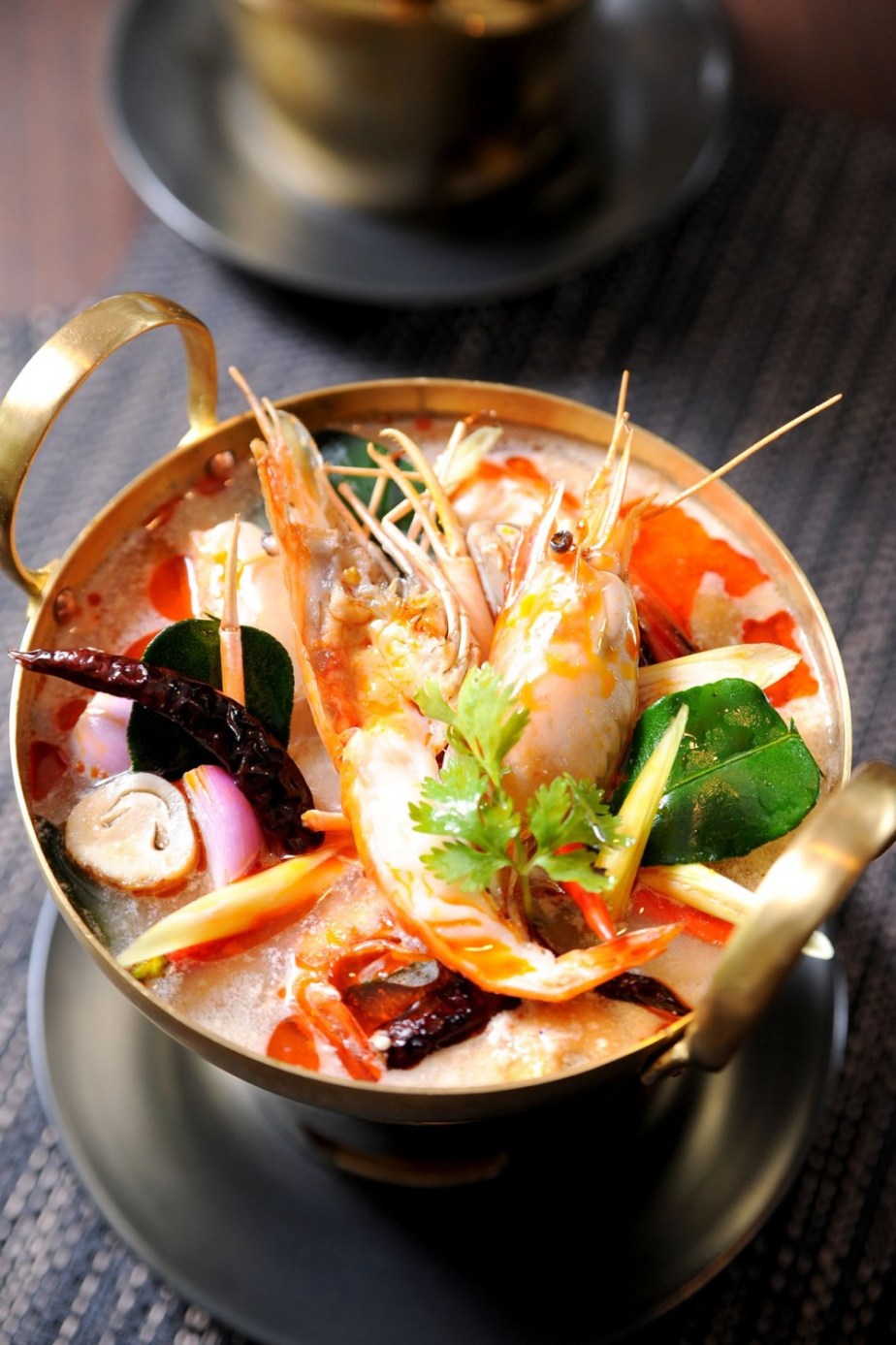 If you ask any foreigners who have ever visited Thailand about their favourite Thai food, their answers, almost without exception, will be tom yam kung.
Tom yam kung, or spicy shrimp soup, is the number one of the top ten Thai dishes loved by foreigners, according to a recent investigation. And in fact, it is one of the most favourite dishes for Thai people as well. It is simply because it is so delicious for its unique sour and spicy taste that you will certainly need it more and more if you try it just once.
Thai food generally not only provides a wonderful taste but also includes medicinal properties in its herbal ingredients as well. Tom yam kung is one of the best examples. To make you acquainted with this special Thai dish, this article will introduce you to the recipe for the soup and its herbal properties.
Ingredients :
1 pint of water
10 large shrimps
1 cup of mushrooms
1 stalk of lemon grass chopped
2 kaffir-lime leaves
1 table spoon of chopped coriander leaves
1/2 teaspoon of ground chilli (the amount can be adjusted according to one’s preference)
1/2 teaspoon of salt
2 tablespoons of lime juice
2 tablespoons of fish sauce
How to cook :
1. Pour the water into a pot, add the lemon grass and kaffir-lime leaves and heat it.
2. Add the shrimps when the water is boiling and cover the pot.
3. Wait for 3 minutes before adding the mushrooms and salt.
4. Leave it to simmer for a few minutes. Then remove from the heat.
5. Season with fish sauce, lime juice and ground chilli.
6. Put the chopped coriander leaves in the pot before serving.
 EASY THAI FOOD